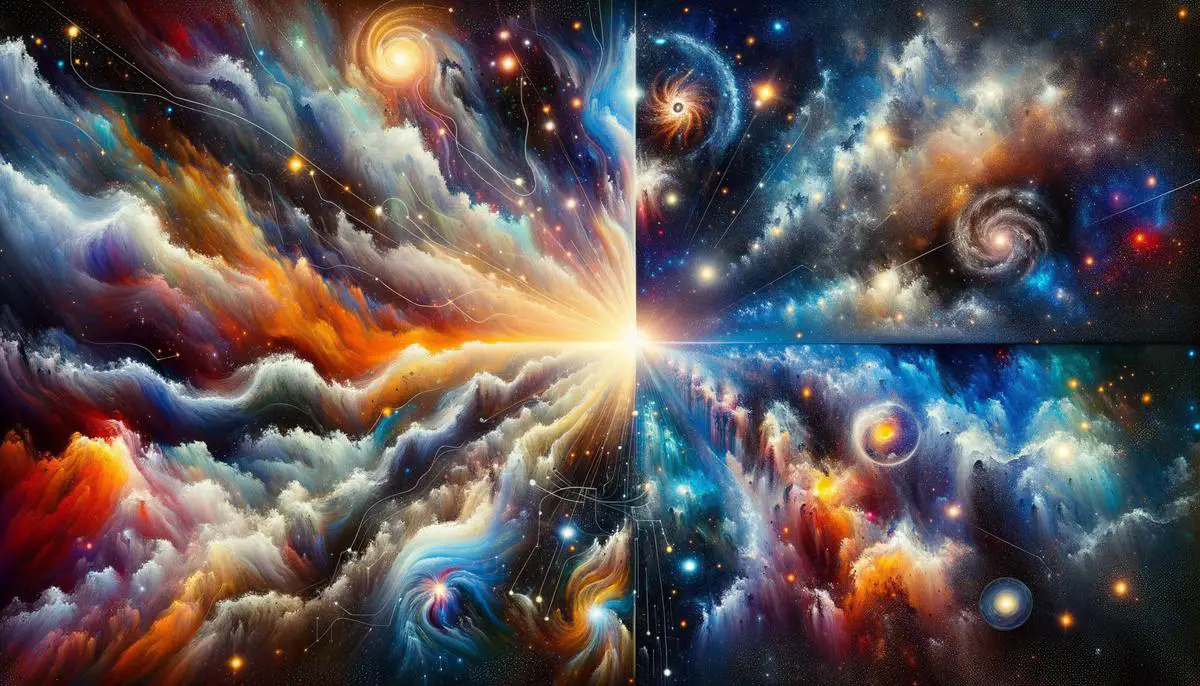
Einstein's Cosmological Constant
Einstein introduced the cosmological constant in 1917 to maintain a static universe in his equations. It acted as a counterforce to gravity, preventing universal collapse. However, when the expanding universe was discovered, Einstein considered it a mistake.
Interestingly, the concept has found new relevance in modern cosmology. Many astronomers now consider the cosmological constant as a potential representation of dark energy, the mysterious force driving the universe's accelerating expansion.
Einstein's equations also described a universe without edges, where space curved like a balloon's surface. Although his static model was superseded, the cosmological constant remains part of our evolving understanding of cosmic dynamics.
Observations by Slipher and Hubble, revealing increasing velocities of spiral nebulae and galactic redshifts, shifted our view from a static to an expanding universe. This evolution in cosmic understanding demonstrates how scientific models adapt to new data, keeping the universe's story full of intriguing developments.
Expansion of the Universe
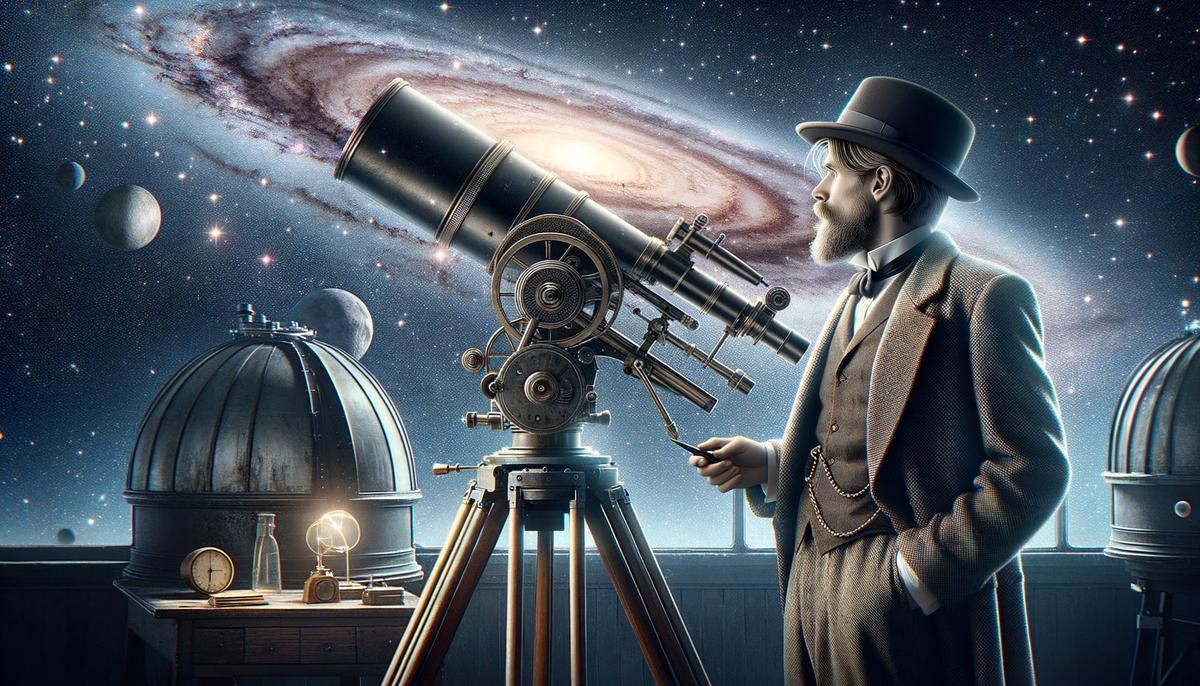
The early 20th century marked a turning point in our cosmic understanding. Vesto Melvin Slipher at Lowell Observatory made groundbreaking observations of spiral nebulae, discovering that most were redshifted, indicating they were moving away at high speeds.
Edwin Hubble, using the 100-inch telescope at Mount Wilson, built upon Slipher's work. By measuring the distances to these nebulae using Cepheid variable stars, Hubble established a linear relationship between a galaxy's distance and its redshift in 1929, fundamentally changing our view of the cosmos.
Georges Lemaître, a Belgian priest-scientist, had theoretically proposed an expanding universe in 1927, connecting cosmic dynamics with observational phenomena. Initially overlooked, Lemaître's work found validation in Hubble's empirical evidence.
The collective insights of Slipher, Hubble, and Lemaître transformed our understanding from a static to an ever-expanding universe. This shift, encapsulated in Hubble's Law, became a cornerstone of modern cosmology, reshaping our perspective on the universe's structure and evolution.
These discoveries remind us that the universe is not just a place, but a dynamic story. Each observation of distant nebulae or galaxies allows us to peer through a lens shaped by those who dared to question and imagine, continually expanding our cosmic horizons.
Dark Matter and Galaxy Formation
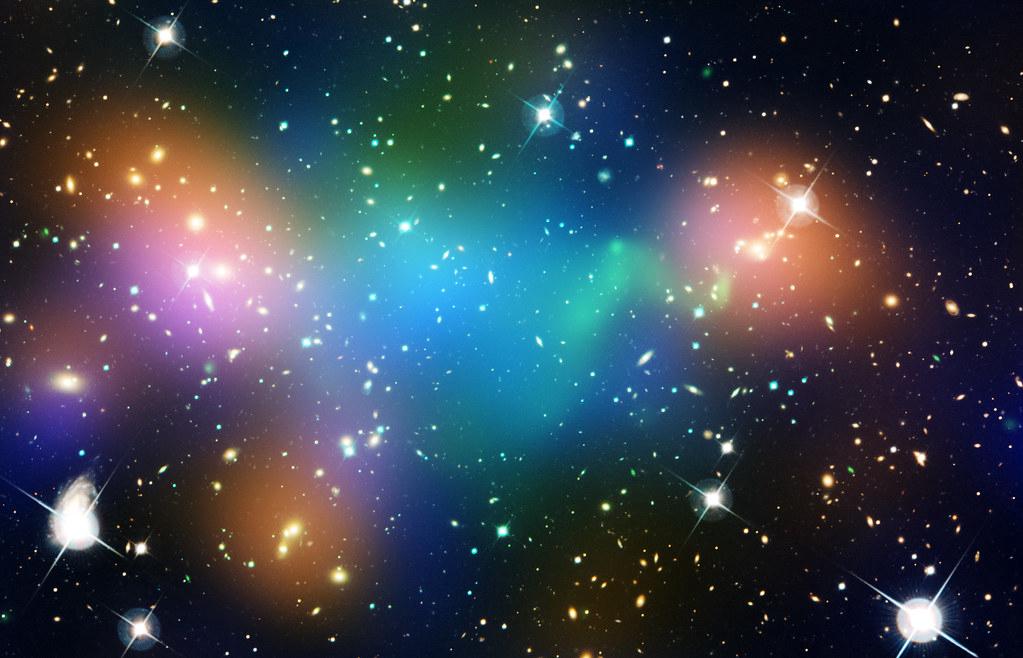
Dark matter plays a crucial role in galaxy formation and evolution, acting as an invisible framework shaping the cosmic landscape. While undetectable by conventional means, its gravitational influence is evident in the structure and behavior of galaxies and galaxy clusters.
Originating from the early universe, dark matter formed vast halos around which ordinary matter accumulated, giving rise to galaxies. This process is analogous to a house's frame, invisible in the finished structure but essential to its form and stability.
The distribution of dark matter throughout the universe acts as a gravitational scaffold, influencing galaxy clustering and movement. Observations of the cosmic microwave background radiation and large-scale galaxy surveys provide evidence of its dominance, though its exact nature remains one of astrophysics' most pressing mysteries.
Dark matter's unique properties allow it to interact gravitationally with ordinary matter while avoiding electromagnetic interactions. This characteristic makes it undetectable through direct observation, but its presence is inferred through gravitational lensing effects.
Our own Milky Way galaxy is believed to be encompassed by a dark matter halo, extending far beyond the visible disk and providing stability to the galactic structure. This concept challenges our understanding of the universe's composition and drives ongoing research and experiments.
The study of dark matter bridges astronomy and fundamental physics, pushing the boundaries of our knowledge about the universe's structure and evolution. As we continue to explore this cosmic mystery, each discovery brings us closer to understanding the true nature of our universe.
Axions and Dark Matter
Axions, hypothetical particles proposed in the late 1970s, have emerged as a promising candidate for dark matter. These particles, originally conceived to address the strong-CP problem in particle physics, could potentially explain the gravitational effects observed in galaxies and galaxy clusters.
The search for axions represents a convergence of particle physics and cosmology. If discovered, they could provide a unifying theory linking subatomic and galactic scales, offering insights into fundamental physics theories such as string theory.
Recent research has focused on detecting axions through their potential interactions with strong magnetic fields. Starburst galaxies like M82, with their intense star formation and strong magnetic fields, are of particular interest as potential axion sources.
While no definitive axion signal has been detected, ongoing observations continue to refine search parameters. Advanced instruments like the Nuclear Spectroscopic Telescope Array (NuSTAR) and future missions aim to probe deeper into the cosmic environment where axions might reside.
The axion hunt exemplifies the ongoing quest to understand dark matter and the fundamental nature of our universe. Each new observation and experiment brings us closer to potentially redefining our cosmic model, demonstrating the ever-expanding frontier of human knowledge in astrophysics.

Cosmic Nucleosynthesis
Cosmic nucleosynthesis describes the formation of elements in the early universe, a process that began moments after the Big Bang. This fundamental concept in cosmology explains the origin of the lightest elements that form the building blocks of our universe.
In 1948, Ralph Alpher and George Gamow published the seminal "αβγ paper," which modeled the early universe's conditions using nuclear physics. They proposed that the universe began as a hot, dense neutron soup, which decayed into protons and electrons as it expanded and cooled.
Within minutes of the Big Bang, conditions allowed for nuclear reactions that fused elementary particles into the lightest nuclei. Alpher and Gamow predicted that this process would result in a universe dominated by hydrogen and helium, with trace amounts of deuterium, helium-3, and lithium.
These predictions align remarkably well with observed elemental abundances in the universe. The cosmic microwave background radiation, discovered in the latter half of the 20th century, provides strong supporting evidence for this model of early universe nucleosynthesis.
Astronomers have further validated these predictions through spectroscopic observations of old stars and interstellar gas clouds, finding elemental ratios that match the theoretical models of cosmic nucleosynthesis.
This theory forms a crucial link in our understanding of the universe's evolution, connecting the earliest moments after the Big Bang to the complex structures we observe today. It demonstrates how fundamental physical processes in the early universe set the stage for the formation of stars, galaxies, and ultimately, life itself.
As we continue to explore the cosmos, from the dance of galaxies to the mysteries of dark matter, we find ourselves part of an ongoing scientific narrative. Each discovery in astrophysics not only expands our knowledge but also reveals new questions, driving us forward in our quest to understand the universe's fundamental nature.
- Alpher RA, Bethe H, Gamow G. The origin of chemical elements. Phys Rev. 1948;73(7):803-804.
- Alpher RA, Herman R. Evolution of the Universe. Nature. 1948;162(4124):774-775.
- Alpher RA, Herman R, Follin JW. Physical Conditions in the Initial Stages of the Expanding Universe. Phys Rev. 1953;92(6):1347-1361.
- Goldschmidt VM. Geochemische Verteilungsgesetze der Elemente, IX. Skr Nor Vidensk Akad Oslo I Mat Naturvidensk Kl. 1938;4:1-148.
- Hubble E. A relation between distance and radial velocity among extra-galactic nebulae. Proc Natl Acad Sci USA. 1929;15(3):168-173.
- Lemaître G. Un Univers homogène de masse constante et de rayon croissant rendant compte de la vitesse radiale des nébuleuses extra-galactiques. Ann Soc Sci Brux. 1927;47:49-59.
