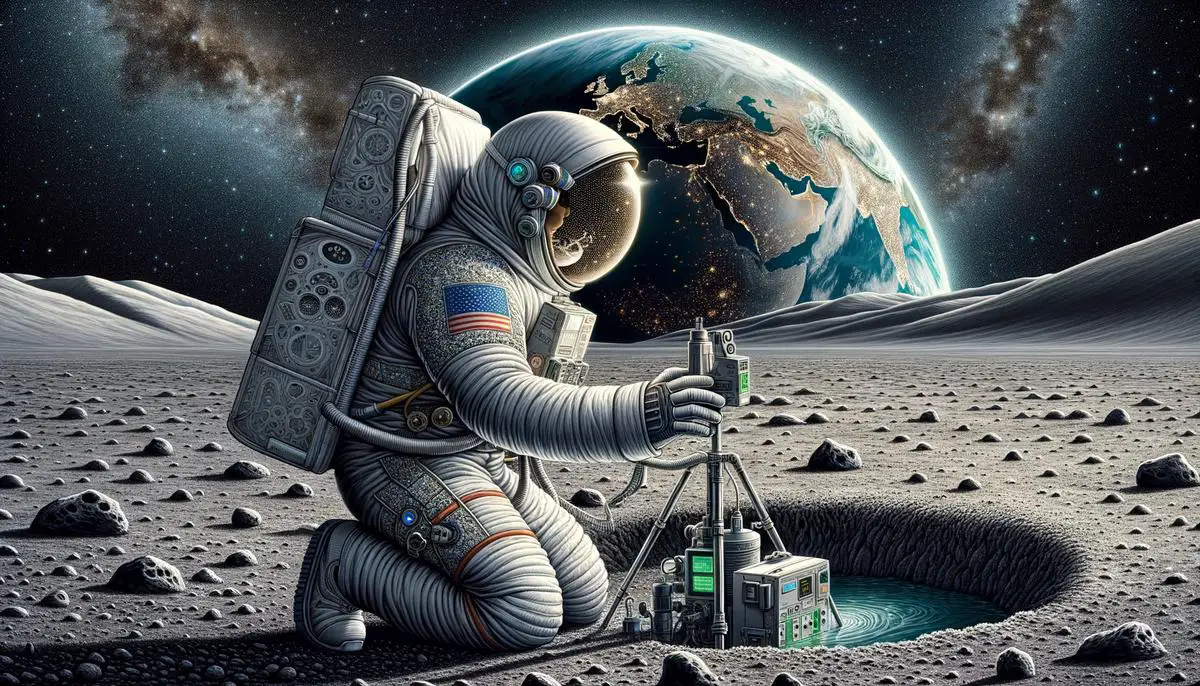
Moon Water Discoveries
The Lunar Reconnaissance Orbiter (LRO) has detected traces of water on the Moon's surface, potentially originating from deep beneath. While the amount is minimal, akin to a parched desert, the discovery itself is significant for future lunar exploration and habitation.
The south pole region shows a higher concentration of these water traces, suggesting varied distribution across lunar terrains. LRO's high-resolution images have also revealed hundreds of pits that could serve as potential shelters for astronauts, offering protection from harsh space weather and proximity to water deposits.
The Moon's interior may host even larger water reserves. A 2017 study hypothesized a significant amount of water within the crust, potentially dwarfing the surface findings. These inner waters could revolutionize our understanding of lunar geology and transform prospects for lunar habitation.
As missions prepare to examine these discoveries further, researchers are focusing on understanding the processes depositing water on the surface. The ongoing research by the LRO portrays the Moon as more than a barren rock, igniting dreams of using these water resources for sustainable human exploration.
Notable Astronomical Events
September 2025 promises a series of celestial events that will captivate both amateur stargazers and seasoned astronomers. The month begins with the Full Corn Moon on September 7, bathing the night in silvery light and offering an optimal opportunity to observe lunar features such as the Sea of Tranquility.
By September 14, the lunar cycle transitions to the third quarter, presenting a half-illuminated moon perfect for studying the contours of its mountains, craters, and seas. The Aristarchus Plateau, known for its luminous ejecta blanket, becomes particularly visible during this phase.
On September 13, Mars will dance near Spica, Virgo's brightest star, offering a captivating contrast against the moon's pale glow. This close encounter provides astronomers with an opportunity to deepen their understanding of planetary motion and gravitational interplay.
The month concludes with a New Moon on September 21, accompanied by a partial solar eclipse visible from the Eastern Hemisphere. This event highlights the moon's role as an essential intermediary in our solar system, influencing light, tides, and time itself.

Potential for Lunar Habitats
The discovery of water traces on the Moon has reignited discussions about sustainable lunar habitats. Although the quantities are minimal, the concentration of water near the lunar south pole offers promise for future exploration and potential colonization.
Lunar pits present innovative possibilities for housing explorers. These naturally occurring formations could mitigate the effects of intense solar radiation and meteor showers, providing safer environments for inhabitants. Imagine lunar villages nestled within these formations, evolving from mere shelters to thriving communities.
- Utilizing lunar water resources presents significant challenges:
- Processing the water requires advanced technology for extraction and purification
- Leveraging water for producing air and fuel could create a self-sustaining ecosystem
- Supporting long-term habitation and exploration
Creating lunar habitats demands construction technology suited for the unforgiving lunar environment. Materials must endure extreme temperatures and withstand the void of space, balancing innovation with an understanding of extraterrestrial conditions.
The intersection of science, technology, and ambition fuels dreams of a sustained lunar presence. Water, as the symbol of life's future on the Moon, illuminates a path toward exploration and habitation, transforming the Moon from a mysterious celestial body into a potential new frontier for humanity.

September 2025 Planetary Highlights
In September 2025, the planets offer their own cosmic spectacles alongside the Moon's journey. Venus emerges as a radiant beacon in the eastern predawn sky, preceding the rising of Jupiter. Together, they create a symphony of lights in the eastern horizon.
Jupiter dominates the eastern sky, its presence commanding even through modest binoculars. Through telescopes, the Galilean moons reveal dynamic relationships that challenge our understanding of satellite systems.
Saturn reaches opposition on September 20-21, allowing its rings to unfurl in full glory. Situated in the constellation Aquarius, Saturn's majestic rings and tilted axis provide a breathtaking view almost all night.
Uranus, less visible to the naked eye but a gem for telescope enthusiasts, begins its westward motion through Taurus on September 6. Its subtle blue-green hue offers a testament to the diversity of planetary systems beyond our immediate perception.
Neptune reaches opposition on September 23, becoming accessible through telescopic observation. The planet's faint azure presence highlights the vast expanses of space separating us from our cosmic neighbors.
These planetary highlights enrich September's sky, encouraging observers to experience the universe from an interconnected vantage point and ponder our place within the boundless cosmos.

Lunar South Pole Water Abundance
The lunar south pole has emerged as a focal point for discussions about lunar water abundance. Missions like the Lunar Reconnaissance Orbiter (LRO) have identified variations in reflectivity suggesting water presence, particularly in perpetually shadowed craters that could preserve ice.
Comparing the lunar south pole to Earth's most arid deserts provides context for the scarcity of water. While current estimates suggest insufficient amounts for sustaining significant human activity without technological intervention, these findings mark a pivotal step in considering extra-terrestrial water sourcing.
"The water quantity is comparable to an extremely dry desert."
However, precise data collection faces inherent limitations. Satellite data provides compelling evidence but grapples with constraints in resolution and depth detection. Distinguishing between bound water integrated within lunar minerals and free ice remains a scientific challenge.
The quest for understanding water at the lunar south pole perseveres as a scientific keystone in humanity's cosmic journey. As improved technologies promise finer analyses, the Moon's shadowed slopes continue to beckon curiosity, offering glimpses of a pristine world poised to redefine humankind's celestial ambitions.

As we gaze upward, the Moon's potential quietly beckons us to imagine a future where its resources sustain human life. The traces of water, though sparse, offer a glimpse into possibilities that could redefine our celestial aspirations. With each discovery, the Moon transforms from a distant companion into a beacon of hope for exploration and habitation.
- Lunar Reconnaissance Orbiter Mission Overview. NASA Science.
- Hayne PO, Bandfield JL, Siegler MA, et al. Global Regolith Thermophysical Properties of the Moon From the Diviner Lunar Radiometer Experiment. J Geophys Res Planets. 2017;122(12):2371-2400.
- Spudis PD, Bussey DBJ, Baloga SM, et al. Evidence for water ice on the Moon: Results for anomalous polar craters from the LRO Mini-RF imaging radar. J Geophys Res Planets. 2013;118(10):2016-2029.
