General Relativity and Space-Time
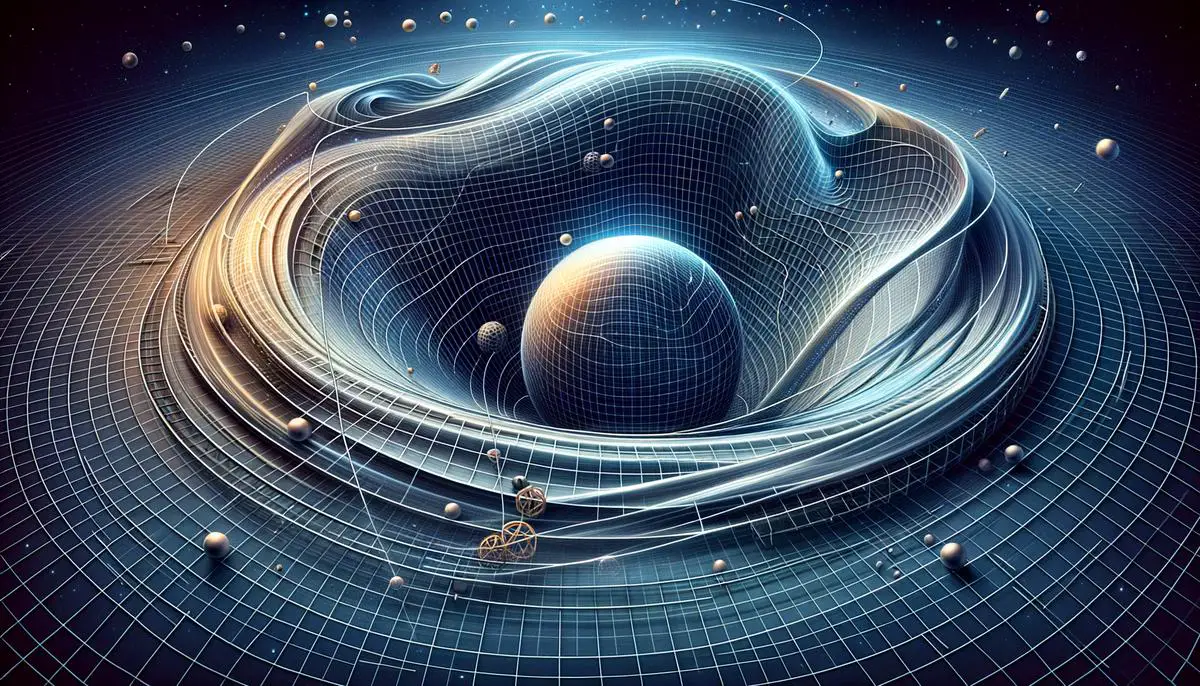
According to Einstein's general relativity, massive objects like galaxies bend the fabric of space-time. This warping dictates the motion of celestial bodies, guiding them along curved paths. Our Milky Way galaxy, with its enormous mass, curves the space-time around it, influencing the orbits of stars like our Sun.
Black holes create extreme distortions in space-time due to their concentrated mass. These distortions are so severe that even light cannot escape beyond the event horizon.
Gravitational waves, ripples in space-time caused by massive cosmic events like colliding black holes, propagate across the universe. These waves stretch and compress space as they travel, providing valuable information about the events that created them.
Gravitational lensing occurs when light from distant objects is bent by the gravity of massive bodies in its path. This effect can produce multiple images of a single object and helps astronomers study the distribution of mass in the universe, including dark matter.
Time dilation, another consequence of general relativity, causes time to pass more slowly in stronger gravitational fields. This effect has been observed in Mercury's orbit around the Sun, demonstrating the real-world implications of Einstein's theory.
Gravitational Lensing
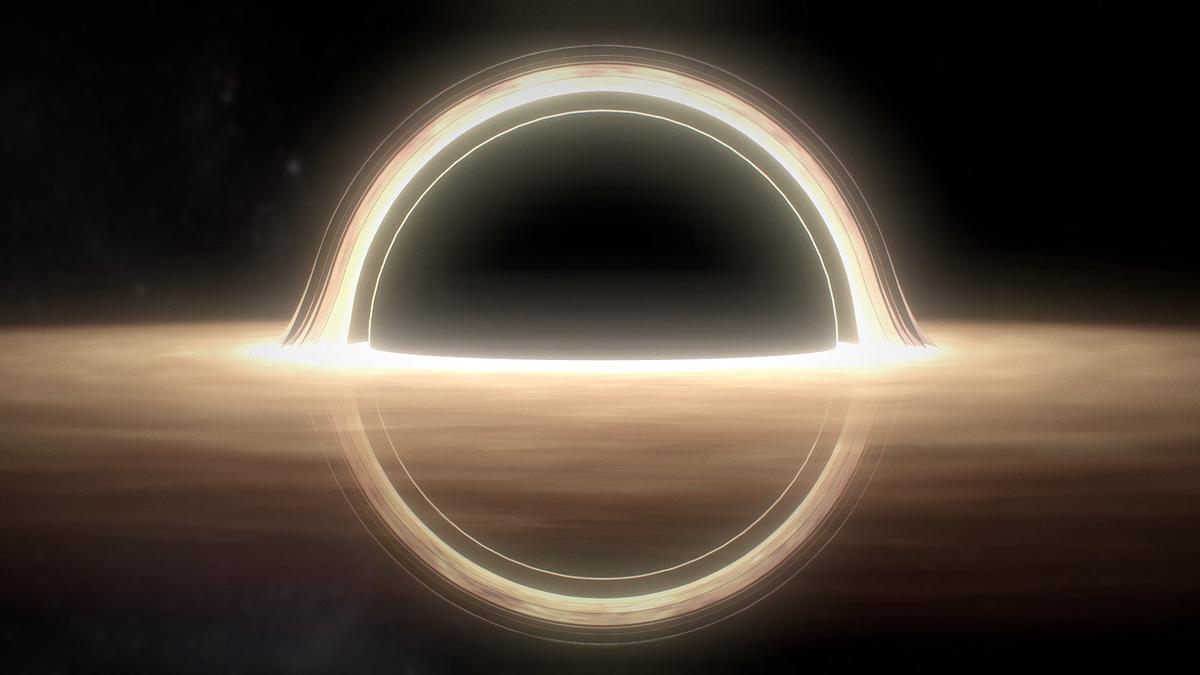
Gravitational lensing occurs when light from a distant object is bent by the gravitational field of a massive intervening object, such as a galaxy or galaxy cluster. This phenomenon can produce multiple images, rings, or arcs of the same distant light source.
A notable example is the Einstein Cross in the Pegasus constellation, where light from a distant quasar is bent around a foreground galaxy, creating four distinct images of the quasar.
Astronomers use gravitational lensing as a tool to:
- Infer the mass distribution of lensing galaxies, including dark matter
- Map dark matter within galaxy clusters
- Study distant galaxies that would otherwise be too faint to observe
- Peer into the early universe, as lensed light can originate from billions of years ago
This natural cosmic telescope enhances our understanding of the universe's structure and evolution, providing insights that would be difficult or impossible to obtain through other means.
Gravitational Waves
Gravitational waves are ripples in space-time generated by massive accelerating objects, such as colliding black holes or neutron stars. These waves propagate across the universe, carrying information about their sources.
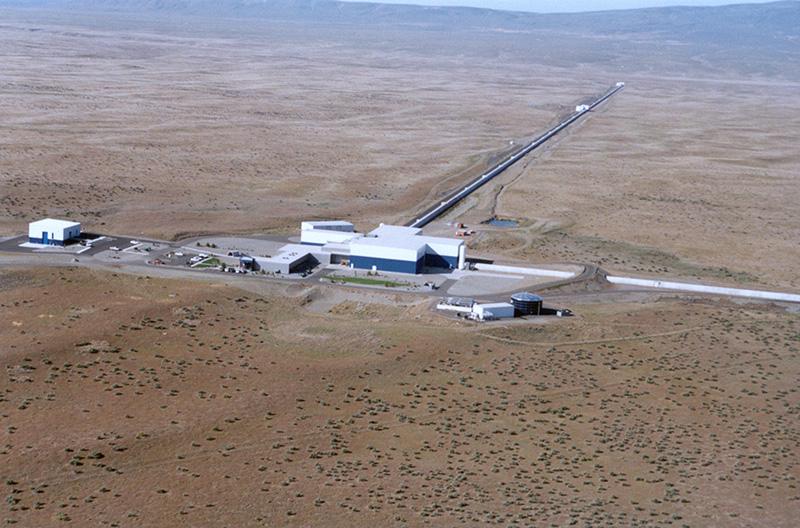
Detection of gravitational waves requires extremely sensitive equipment. Observatories like LIGO and Virgo use laser interferometers to measure minute changes in space-time as waves pass through Earth.
The first direct detection of gravitational waves in 2015 confirmed Einstein's prediction and opened a new era of gravitational wave astronomy. This detection revealed the merger of two black holes, each about 30 times the mass of the Sun.
Gravitational waves provide unique insights into cosmic events and objects:
- Characteristics of their sources, such as mass and spin
- Direct measurement of distances to cosmic events
- Information about environments invisible to traditional telescopes
- Confirmation of theoretical predictions about massive stellar remnants
Combined with traditional electromagnetic observations, gravitational waves enable multi-messenger astronomy, offering a more comprehensive view of cosmic phenomena.
As a tool for exploration, gravitational waves extend our ability to study the universe, potentially revealing insights into its earliest moments and most extreme objects.
Galaxy Mass and Orbital Dynamics
The mass of a galaxy significantly influences the orbits of stars, planets, and other celestial bodies within it. This gravitational influence shapes the structure and dynamics of galaxies and their surrounding environments.
In our Milky Way, the Sun completes an orbit around the galactic center every 225 million years, demonstrating the long-term effects of galactic mass on stellar motion. The galaxy's gravitational pull also affects the distribution of dark matter in its extensive halo.
On a smaller scale, planetary orbits within solar systems are similarly governed by gravitational forces. Mercury's orbit, for instance, exhibits a subtle shift due to the curvature of space-time around the Sun, a phenomenon explained by Einstein's general relativity.
Frame-dragging, another relativistic effect, occurs when massive rotating objects like planets or galaxies twist nearby space-time. NASA's Gravity Probe B confirmed this effect for Earth, showing that our planet's rotation drags space-time around with it.
These phenomena illustrate the profound interplay between mass and space-time, revealing the underlying principles that govern the structure and evolution of cosmic systems across various scales.
Dark Matter and Galaxy Formation
Dark matter plays a crucial role in galaxy formation and structure, despite being invisible to direct observation. Its gravitational influence shapes the cosmos in several ways:
- Provides a framework for galaxy formation in the early universe
- Helps maintain galactic structure by counterbalancing rotational forces
- Contributes to the formation and stability of galaxy clusters
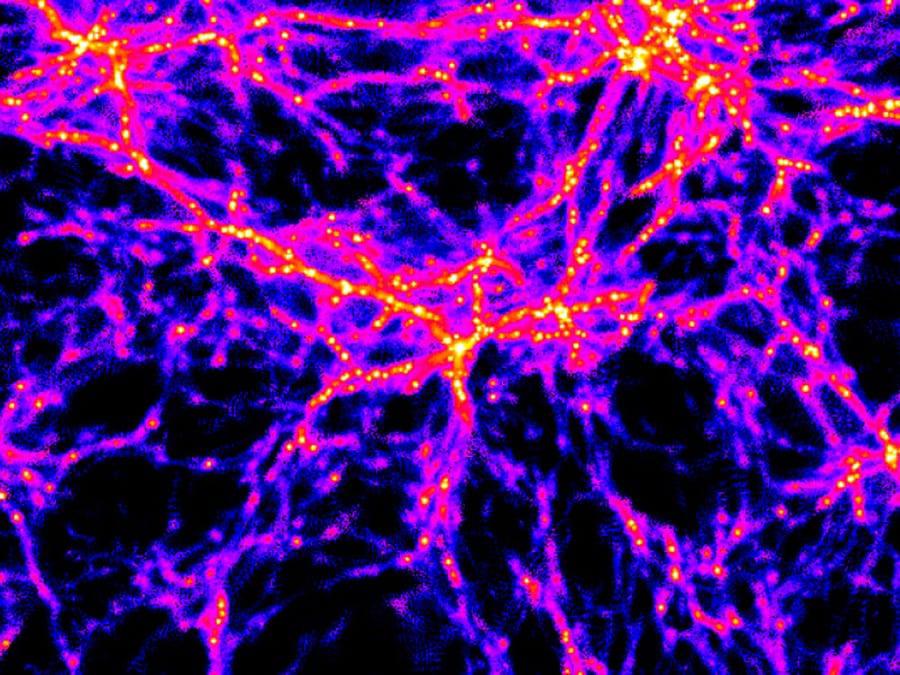
- Shapes the cosmic web, influencing large-scale structure formation
Dark matter's presence is inferred through its gravitational effects, such as gravitational lensing in galaxy clusters. This phenomenon allows astronomers to map dark matter distribution indirectly.
The nature of dark matter remains one of the most significant unsolved mysteries in physics. It doesn't interact with light or electromagnetic forces, making direct detection challenging. This elusiveness pushes the boundaries of particle physics and cosmology, driving new research and potentially leading to revolutionary discoveries about the fundamental nature of the universe.
Understanding dark matter's role in cosmic structure formation is crucial for developing a complete picture of the universe's evolution and current state. As research progresses, dark matter continues to be a key focus in our quest to unravel the cosmos' deepest secrets.
The interplay between mass and space-time fundamentally shapes our universe, from the orbits of planets to the formation of galaxies. As we continue to study these phenomena, we gain deeper insights into the nature of the cosmos and our place within it.
- Weinberg S. Cosmology. New York: Oxford University Press; 2008.
- Komatsu E, et al. Seven-year Wilkinson Microwave Anisotropy Probe (WMAP) Observations: Cosmological Interpretation. Astrophys J Suppl. 2011;192(2):18.
- Suzuki N, et al. The Hubble Space Telescope Cluster Supernova Survey. V. Improving the Dark-energy Constraints above z > 1 and Building an Early-type-hosted Supernova Sample. Astrophys J. 2012;746(1):85.
- Reid BA, et al. Cosmological constraints from the clustering of the Sloan Digital Sky Survey DR7 luminous red galaxies. Mon Not R Astron Soc. 2010;404(1):60-85.
- Perivolaropoulos L. Large Scale Cosmological Anomalies and Inhomogeneous Dark Energy. Galaxies. 2014;2(1):22-61.
