Formation and Composition
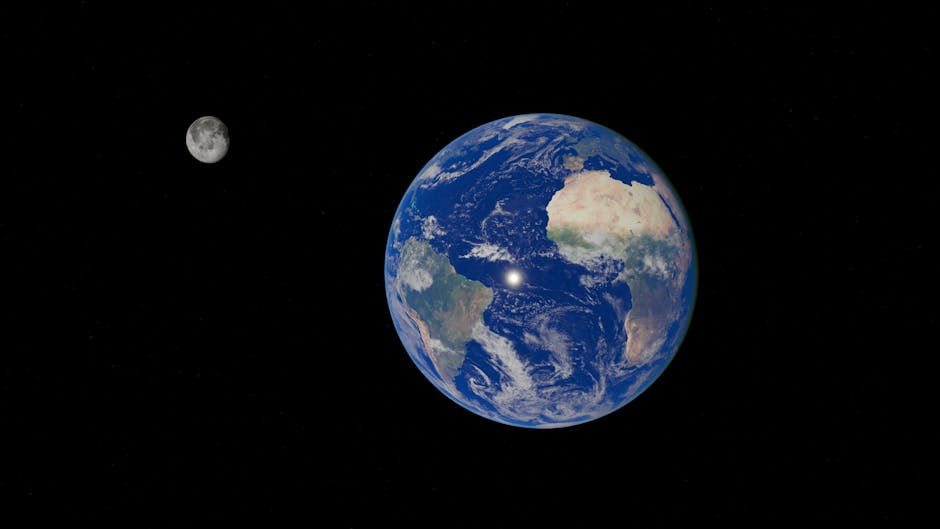
The Moon's formation is attributed to the giant impact hypothesis, where early Earth collided with a Mars-sized object called Theia. This event sent molten debris into orbit, eventually forming our Moon. This origin explains the chemical similarities between Earth and the Moon, as well as the Moon's lower density (3.34 g/cm³ compared to Earth's 5.5 g/cm³).
Compared to other moons in our solar system, Earth's Moon has distinct characteristics:
- Jupiter's Ganymede, the largest moon, is denser and icy.
- Saturn's Titan has a thick atmosphere and possibly liquid seas beneath its surface.
- Europa and Enceladus may have subsurface oceans warmed by tidal heating, a phenomenon absent on our Moon.
The Moon's surface features tell a story of countless impacts over billions of years, resulting in craters and maria (dark plains). Unlike some other moons, it lacks an atmosphere or hidden oceans. Despite its less dramatic appearance, the Moon plays a crucial role in stabilizing Earth's tilt and influencing its climate.

Size and Scale
The Moon, approximately 238,855 miles from Earth, has a diameter of 3,475 kilometers, about one-fourth of Earth's 12,742 kilometers. This makes it the largest moon in relation to its planet when considering diameter ratio.
This size gives the Moon significant influence over Earth:
- It stabilizes Earth's axial tilt, keeping it within a range of about 2.4 degrees.
- This stability limits drastic seasonal changes and protects Earth from the climate instability seen on planets like Mars, which lacks a significant moon.
- The Moon's gravitational pull drives Earth's tides, influencing coastal habitats and marine life.
While it may not have the complex features of moons like Ganymede or Io, the Moon's size and proximity to Earth make it a crucial factor in maintaining conditions suitable for life on our planet.

Orbital Dynamics and Effects
The Moon orbits Earth every 27.3 days in a nearly circular path. This orbital dance creates oceanic tides through gravitational interactions, especially when the Moon aligns with the Sun. These tides have long influenced maritime activities and coastal ecosystems.
The Moon's gravitational force also stabilizes Earth's axial tilt, preventing extreme variations that could lead to dramatic climate shifts. Without the Moon, Earth's tilt could potentially swing up to 50 degrees, similar to Mars. Instead, Earth's tilt only varies slightly over a 41,000-year cycle.
Eclipses occur when the Moon's orbit aligns perfectly with the Earth and Sun:
- Solar eclipses happen when the Moon blocks the Sun from Earth's perspective
- Lunar eclipses occur when Earth's shadow falls on the Moon
Compared to other moons in our solar system, Earth's Moon has a uniquely significant impact on its parent planet. Mars' moons, Phobos and Deimos, are too small to affect the planet's tilt or climate substantially. Even Jupiter's large moon Ganymede doesn't significantly alter its parent planet's orientation.
Exploration and Human Interaction
Human fascination with the Moon dates back to ancient civilizations, who used it to track time and understand celestial mechanics. Early telescopic observations by Galileo and Copernicus further expanded our knowledge of lunar features.
The Space Age marked a new era in lunar exploration:
- 1959: Soviet Union's Luna 2 became the first human-made object to impact the Moon
- 1959: Luna 3 provided the first images of the Moon's far side
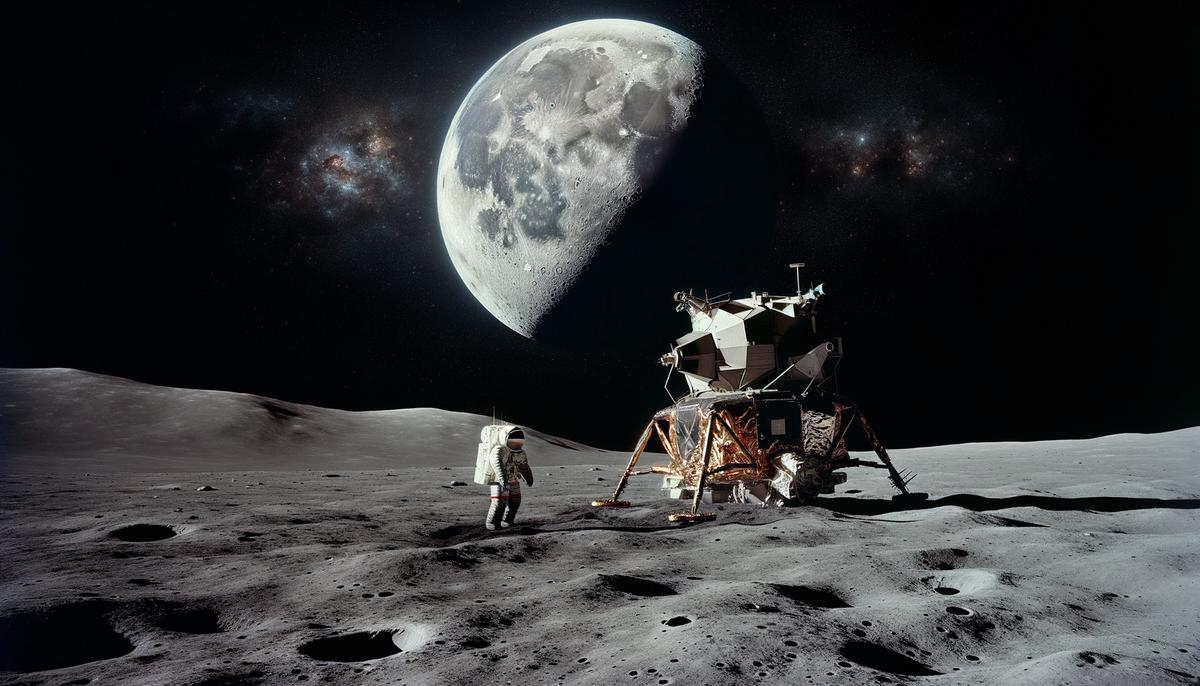
- 1969-1972: NASA's Apollo missions, including six successful landings, represented a pinnacle of human achievement
After a period of reduced focus, lunar exploration has seen renewed interest. Countries like China, India, and the European Union have launched their own lunar missions. NASA's Artemis program aims to return humans to the Moon and establish a sustainable presence by the end of the decade, potentially serving as a stepping stone for future Mars missions.
The Moon remains the only celestial body humans have physically visited, underscoring its importance in space exploration. Our ongoing efforts to understand and interact with the Moon continue to drive scientific progress and inspire future generations of explorers.
The Moon's presence has played a vital role in shaping Earth's environment and nurturing life through its gravitational influence. Our relationship with this celestial neighbor continues to inspire and propel us toward new horizons in space exploration.
- Nature Communications. Earth's sweet spot for life-friendly moons. 2024.
- NASA. Lunar Exploration Program Overview. 2023.
- Park RS, et al. A hemispheric asymmetry in the lunar deep mantle. Nature. 2023.
- International Astronomical Union. Naming of Astronomical Objects. 2022.
- NASA. Gravity Recovery and Interior Laboratory (GRAIL) Mission. 2012.
